Sweat Rate Calculator
Weigh in before and after a session to estimate how much you sweat per hour. Enter weight before and after (kg or lb), exercise time in minutes, fluid drunk and, optionally, urine passed (ml, L or fl oz). Your numbers stay on your device.
Short answer: Sweat rate = (weight before − weight after + fluid drunk − urine passed) ÷ hours of exercise, treating 1 kg as about 1 L. It describes one session in those conditions, not a fixed amount you must drink every hour.
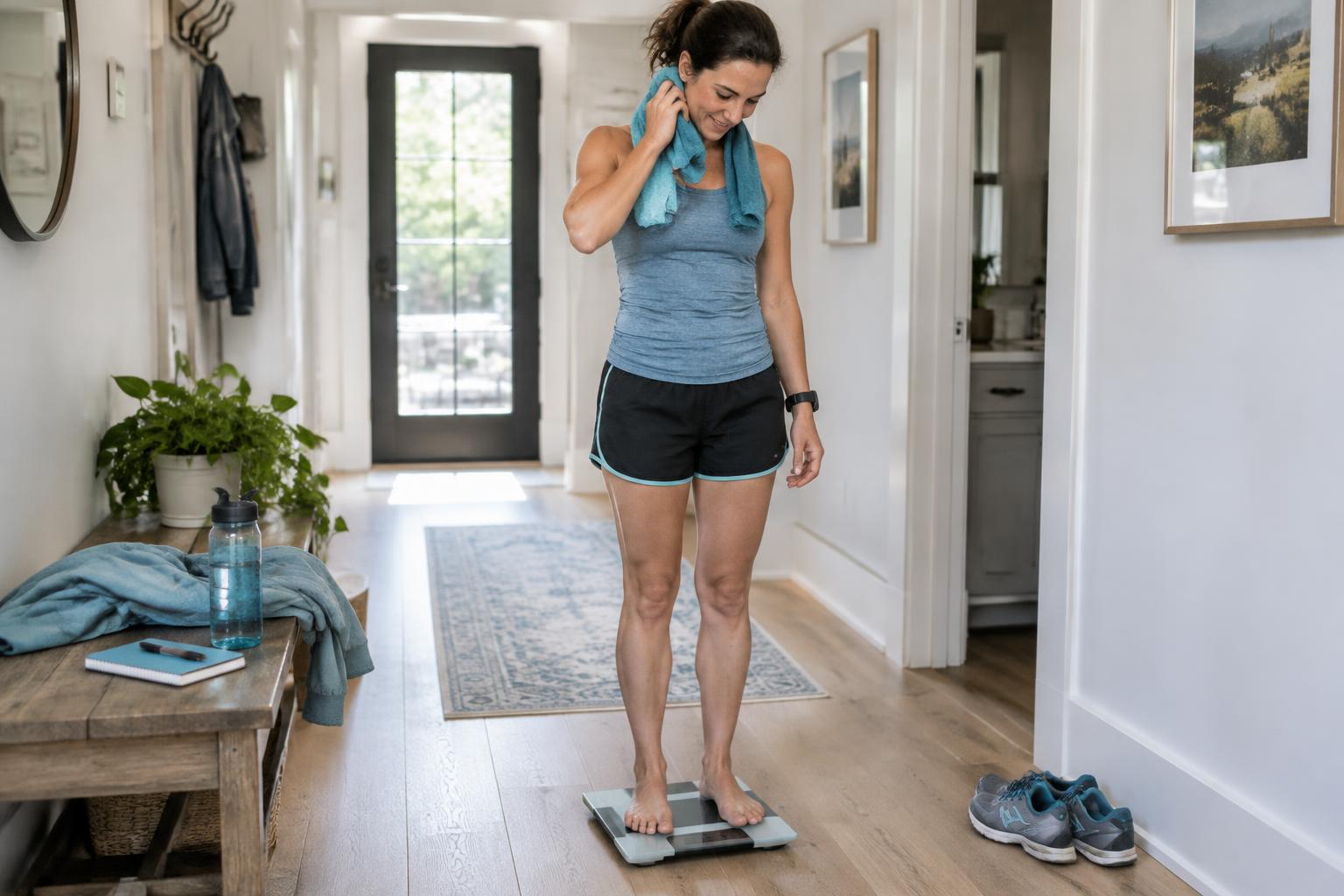
In practice
What you need for one measurement
A scale you can reuse, a way to measure what you drink (a bottle with known volume works), a watch, and a towel. Urine volume is optional but improves the estimate if you pass urine during the session. Activity, weather and effort are worth noting so you can compare sessions later.
Required
Body weight before and after, on the same scale, and the exercise time in minutes.
Strongly recommended
Everything you drank during the session. Left blank, it is shown as not recorded and the estimate may be low.
Optional
Urine passed during the session, plus activity, conditions and perceived effort for your own records.
How the model works
How the calculation works
This is the field method used by the Gatorade Sports Science Institute and the Korey Stringer Institute, and described in Baker's 2017 review of sweat testing. The body-mass change is converted to water at about 1 kg = 1 L, fluid drunk is added back because it replaced some of the sweat, and urine is subtracted because it left the body without being sweat.
Weight before
80.0 kg
Weight after
79.4 kg
Fluid drunk
0.5 L
Urine
0 L
Sweat loss over 60 minutes
1.1 L → 1.10 L/hour
Calculated with the same engine as the calculator above.
Evidence
Three worked examples
The same session can look very different depending on what you drank and whether you passed urine. All three are computed by the calculator's own engine.
| Session (60 min) | Arithmetic | Sweat rate |
|---|---|---|
| 80.0 → 79.4 kg, drank 500 ml | 0.6 + 0.5 − 0 = 1.1 L | 1.10 L/hour |
| Same, plus 300 ml urine | 0.6 + 0.5 − 0.3 = 0.8 L | 0.80 L/hour |
| 80.0 → 80.5 kg, drank 1.5 L | −0.5 + 1.5 − 0 = 1.0 L | 1.00 L/hour |
80.0 → 79.4 kg, drank 500 ml
Arithmetic: 0.6 + 0.5 − 0 = 1.1 L
Sweat rate: 1.10 L/hour
Same, plus 300 ml urine
Arithmetic: 0.6 + 0.5 − 0.3 = 0.8 L
Sweat rate: 0.80 L/hour
80.0 → 80.5 kg, drank 1.5 L
Arithmetic: −0.5 + 1.5 − 0 = 1.0 L
Sweat rate: 1.00 L/hour
In practice
Common measurement mistakes
- Weighing in wet clothes. Sweat trapped in a shirt or shoes stays on the scale and hides part of the loss — towel off and weigh in the same dry clothing.
- Different scales or positions. Use the same scale on the same floor spot; many bathroom scales only read in 0.1–0.5 kg steps, which matters in a short session.
- Forgetting drinks or urine. A missed 500 ml bottle changes a one-hour result by 0.5 L/hour.
- Eating during the session. Food adds weight that is not water; the simple method does not correct for it.
- Entering hours as minutes. The time field is in minutes.
Evidence
Why your result changes from session to session
ACSM reports sweat rates from roughly 0.3 to 2.4 L per hour, and Baker (2017) describes large differences between people and within the same person. Temperature, humidity, sun, intensity, duration, clothing, fitness and heat acclimatization all play a role. A cool easy run and a hot hard session can differ by a factor of two or more for the same person.
NATA therefore recommends assessing sweat rate in conditions that resemble the training or competition you are planning for. A few measurements across different conditions tell you much more than one number.
Safety
How to read your result — and how not to
Your sweat rate is an estimate of water lost in one session. It is not a target to drink every hour. Many athletes aim to limit losses during long sessions rather than to replace every millilitre, and drinking beyond your losses can lead to exercise-associated hyponatremia, a documented risk in endurance events (Hew-Butler et al., 2015). The result also says nothing reliable about sodium loss, which needs a different test.
If a clinician has given you a fluid limit, or you have a condition or take medicine that affects fluid balance, follow that individual advice. For recovery after a session, see how much to drink after exercise.
How the model works
Limits of the field method
The method treats all body-mass change as water. It does not correct for water lost through breathing, the small mass lost by burning fuel, or food eaten during the session; the GSSI calculator includes optional food entries for that reason. These effects are usually small over an hour but grow in long events. The 1 kg ≈ 1 L conversion is an approximation, and scale precision limits short sessions. Treat the result as a well-founded estimate, not a laboratory measurement.
Sources & scope
- Gatorade Sports Science Institute: Fluid Loss Calculator
Field method using pre/post body mass, fluid, urine and optional food.
- Baker LB (2017). Sweating rate and sweat sodium concentration in athletes. Sports Medicine
Methodology, variability and limitations of sweat testing.
- Korey Stringer Institute: Hydration
Practical sweat-rate measurement for athletes.
- ACSM position stand: Exercise and Fluid Replacement (2007)
Typical sweat-rate range and individualized replacement.
- NATA position statement: Fluid Replacement for the Physically Active (2017)
Assess sweat rate in representative conditions.
- Hew-Butler et al. (2015). Exercise-Associated Hyponatremia consensus
Risk of drinking beyond losses during prolonged exercise.
SnapWaterCalc editorial guidance · Methodology · Full source list