How Many Bottles of Water Should I Drink a Day?
Short answer: There is no universal daily bottle count: divide the drinking volume you want to track by your bottle's capacity. For example, 2 liters fills four 500 ml bottles. That is a conversion, not a recommendation to drink 2 liters.
Enter your daily water target and your bottle size. You get bottle equivalents, including partial bottles, and a rounded-up count for planning.
This calculator converts a target into bottles — it does not decide what your target should be. Don't know yours? Calculate your daily water intake first.
Bottle sizes: 500 ml / 16.9 fl oz, 20 fl oz, 24 fl oz, 32 fl oz, 40 fl oz, 1 L, or a custom size in ml, L or fl oz.
How many water bottles are in a gallon?
One US gallon is 128 fl oz (3.79 L). With standard 16.9 fl oz (500 ml) bottles that is about 7.6 bottles — so 8 full bottles to reach a gallon.
| Bottle size | Bottles per gallon | Full bottles |
|---|---|---|
| 500 ml / 16.9 fl oz | 7.57 | 8 |
| 20 fl oz | 6.4 | 7 |
| 24 fl oz | 5.33 | 6 |
| 32 fl oz | 4 | 4 |
| 40 fl oz | 3.2 | 4 |
| 1 L | 3.79 | 4 |
US gallon only (the UK imperial gallon is 4.55 L). A gallon is a conversion example, not a recommended daily amount.
Bottles per day chart
| Daily target | 500 ml / 16.9 fl oz | 20 fl oz | 24 fl oz | 32 fl oz | 40 fl oz |
|---|---|---|---|---|---|
| 2 L (67.6 fl oz) | 4 | 3.4 | 2.8 | 2.1 | 1.7 |
| 64 fl oz (1.89 L) | 3.8 | 3.2 | 2.7 | 2 | 1.6 |
| 2.5 L (84.5 fl oz) | 5 | 4.2 | 3.5 | 2.6 | 2.1 |
| 80 fl oz (2.37 L) | 4.7 | 4 | 3.3 | 2.5 | 2 |
| 3 L (101.4 fl oz) | 6 | 5.1 | 4.2 | 3.2 | 2.5 |
| 100 fl oz (2.96 L) | 5.9 | 5 | 4.2 | 3.1 | 2.5 |
| 1 gallon (128 fl oz, 3.79 L) | 7.6 | 6.4 | 5.3 | 4 | 3.2 |
Quick answers
How many water bottles is 2 liters?
2 L ÷ 500 ml = 4 bottles (4 bottles' capacity; the last may be partial).
How many water bottles is 3 liters?
3 L ÷ 500 ml = 6 bottles (6 bottles' capacity; the last may be partial).
80 oz of water is how many bottles?
80 fl oz ÷ 16.9 fl oz = 4.73 bottles (5 bottles' capacity; the last may be partial).
How many water bottles is a gallon?
128 fl oz ÷ 16.9 fl oz = 7.57 bottles (8 bottles' capacity; the last may be partial).
How many bottles of water is 8 cups (64 fl oz)?
64 fl oz ÷ 16.9 fl oz = 3.79 bottles (4 bottles' capacity; the last may be partial).
How the conversion works
Bottles = daily target ÷ bottle size. Both values are converted to milliliters first. One US fluid ounce is 29.57 ml. The full-bottle number rounds up so it meets or slightly exceeds your target.
In practice
Choose the right volume before counting bottles
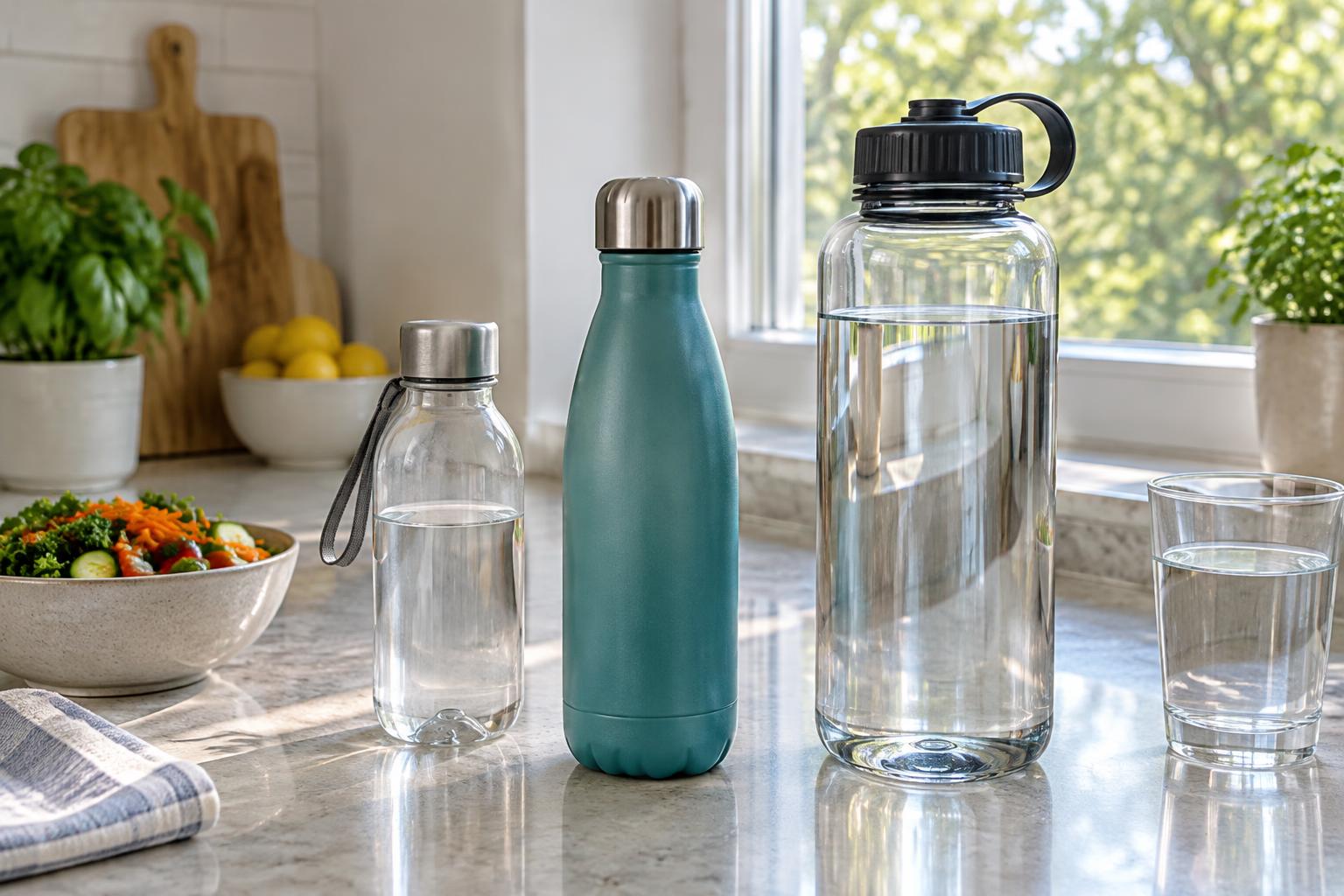
A bottle is a measuring container, not a biological unit. Four small bottles and two large bottles may hold the same volume. Before you count, decide whether you are tracking plain water alone or all beverages, and check the capacity printed on your bottle.
If you are starting from a total-water reference value, do not pour that whole figure into the calculator as a plain-water prescription. Total water also includes other beverages and moisture in food. SnapWaterCalc's main calculator shows published population references; it does not measure your personal requirement.
- 1
Define the target
Use the drink volume you intend to track, or a clinician-directed amount where applicable.
- 2
Check the bottle
Use its labeled capacity, not a guess based on appearance. A partly filled bottle is not a full bottle.
- 3
Count what you actually drink
Refills and partial bottles count by volume; other drinks should not disappear from your record.
This checklist clarifies tracking. It does not select a healthy daily amount.
How the model works
A partial bottle is often the most useful answer
Suppose you have chosen to track 2.5 L of drinks in a 750 ml bottle. The conversion gives 3.33 bottles: three full bottles and 250 ml from the next one. Four full bottles hold 3 L, so the rounded-up count is a container-planning shortcut, not an instruction to finish the extra water.
You can refill one reusable bottle rather than use several separate bottles. Count consumed volume, not how many containers you own or how many times you opened the cap.
Chosen example
2,500 ml
Bottle capacity
750 ml
Bottle equivalents
3.33
Computed by the same conversion engine as the tool. Three full bottles plus 250 ml; this is not a drinking recommendation.
Evidence
What the adult reference values mean
The European Food Safety Authority (2010) gives adult adequate-intake values of 2.0 L for women and 2.5 L for men under moderate environmental temperature and moderate activity. The U.S. National Academies (2005) gives 2.7 L for women and 3.7 L for men. All four figures concern total water from drinking water, other beverages and food.
These are population reference values, not individual measurements, universal minimums or bottle quotas. Their different derivations also mean that the European and U.S. figures should not be averaged into a “correct” bottle target. Food moisture varies with diet; do not assume a fixed subtraction fits every day.
| Reference | Adult women | Adult men |
|---|---|---|
| EFSA, 2010 | 2.0 L total water | 2.5 L total water |
| National Academies, 2005 | 2.7 L total water | 3.7 L total water |
EFSA, 2010
Adult women: 2.0 L total water
Adult men: 2.5 L total water
National Academies, 2005
Adult women: 2.7 L total water
Adult men: 3.7 L total water
Other drinks do not disappear from the total
If you drink tea at breakfast or milk with a meal, a tally of plain-water bottles does not describe all your beverage intake. Decide what your chosen target represents before comparing it with that tally. Otherwise, you can count the same water twice or overlook drinks entirely.
The Beverage Hydration Index explains measured short-term comparisons between drinks. It is not a multiplier to apply to every cup in a daily log. Keep the distinction between beverage volume and study-specific fluid retention.
Liters, ounces and gallons: keep the definitions straight
The tool converts both values to milliliters, then divides target volume by bottle volume. Its ounces are U.S. fluid ounces, a volume unit, not ounces of weight. Its gallon is the U.S. liquid gallon: 128 U.S. fl oz, approximately 3.79 L. An imperial gallon is larger, approximately 4.55 L.
A 500 ml bottle is approximately 16.9 U.S. fl oz, not exactly equal to it. Enter the unit and capacity from the label for the closest conversion. Small differences in displayed counts can reflect those rounded labels, not a change in the underlying volume.
Safety
Use a count as a planning aid, not a test to pass
Do not force yourself to finish the rounded-up number solely to complete a bottle goal. The result cannot tell you whether the entered amount is appropriate. For long or sweaty exercise, read the exercise and sweat-loss guide rather than relying on a fixed count.
If a clinician has specified a fluid restriction or target, follow that plan and ask which drinks or foods it includes. The converter can help with units but cannot change the medical limit.
Bottom line: bottle count becomes useful only after you have defined the volume being tracked. Exact volume, partial refills and clear units matter more than finishing a round number of bottles.
Sources & scope
- EFSA: Dietary Reference Values for water (2010)
Adult adequate intakes for total water, including food and all drinks; moderate temperature and activity.
- National Academies: Dietary Reference Intakes (2005)
U.S. adequate intakes for total water, not a plain-water bottle prescription.
- SnapWaterCalc conversion methodology
Bottle counts are unit conversions. Example and table values use the same bottle conversion engine, not a new hydration formula.
SnapWaterCalc editorial guidance · Methodology · Full source list